
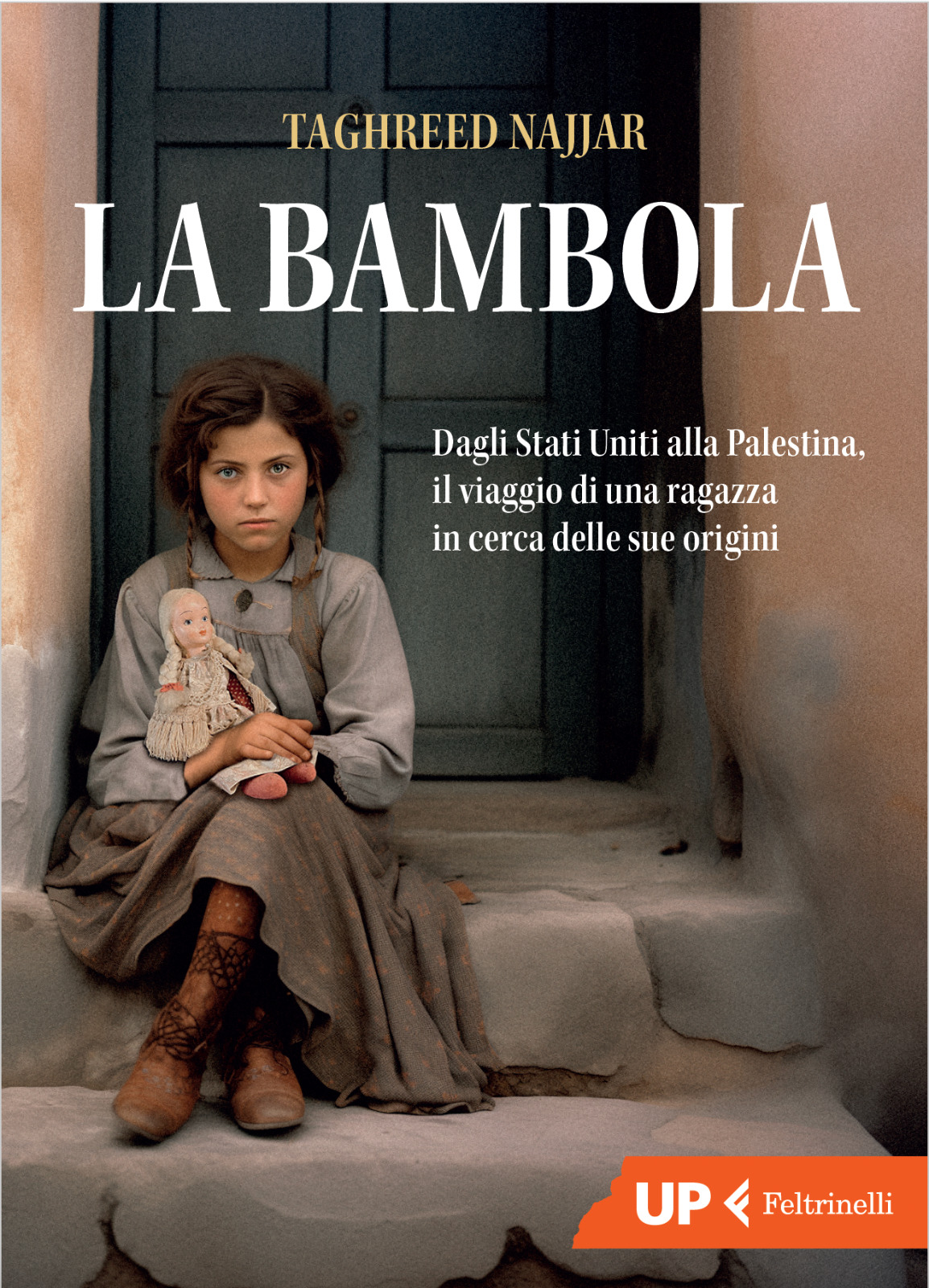
A review of the book “The Doll” by Italian writer Elvira Rossi
A lost doll, found after fifty years, connects three generations of women who share their stories through it. Their lives intertwine with the history of Palestine, starting from the Nakba of 1948.
The doll, Sally, is left behind in a house in Jaffa when Leila’s parents decide to move to Beirut with their five children to escape the violence of the Israeli occupation, hoping to return someday. The rushed departure and the single suitcase do not allow them to take Sally. It soon becomes clear that the Nakba makes returning difficult, and like many Palestinians, they will have to resign themselves to living as refugees.
From that terrible day of separation from their land, all that remains of the doll for Leila, now a mother and grandmother living in Chicago, is a tender memory and the image imprinted on one of the old family photos. It is this picture that sparks the interest of her granddaughter Nada, who asks her grandmother for a doll similar to the one from her childhood. In the arduous search, grandmother Leila will be assisted by her eldest granddaughter, Arwa, who, helped by her friend Sarah, will set out to find a doll as similar to the original as possible.
The present chases the past, and on eBay, the real Sally appears. The adventurous search is not without twists and turns, and moments of tension are inevitable. A distinctive mark makes her recognizable, but finding her is not enough.
One question remains: How did the doll travel from Jaffa to the United States? The rediscovered doll opens a window to a painful past, still vivid in memory.
The story told by Taghreed Najjar in the novel is not a fairy tale: it is the sad story of a family, part of a people denied the right to exist.
The narrative becomes a form of resistance to the theft of identity. The author, Taghreed Najjar, intentionally focuses on female characters because women have always, silently and far from the noise of weapons, written history, passing it down from generation to generation, ensuring the transmission of knowledge that defines a civilization.
Women prove to be resolute, capable of overcoming even the most piercing pain, ready to rise from defeat; they lead their families without dominating, guiding their children in their choices.
Their pragmatism, imposed by circumstances, is not isolated; it is colored by human values, deep feelings, and dreams, the pinnacle of which is an unwavering desire for a future of freedom for their distant land.
Through everyday gestures, from the Arabic language to the spicy aromas of cooking, grandmother Leila tells the story of Palestine to the generation of children and grandchildren born in exile, ensuring that the roots are not forgotten. Daily routines are not without imperfections, as generational conflicts arise but are quickly healed by the will to stay united.
If mothers do not renounce a child even when they make mistakes, the fathers, who remain on the margins of the narrative, reveal themselves to be inflexible and sometimes violent. The acts of tenderness they manage to express are not enough to absolve them of their chauvinistic behavior.
For grandmother Leila, an educated woman, speaking at conferences or writing about Palestine is a mission to strengthen the identity of those who belong to it, and even more so, to spread knowledge based on direct testimony, more convincing than information often distorted.
The fate of Palestinians is to be scattered around the world, but what keeps them closely connected to their land is a strong sense of belonging, and every meeting becomes an occasion to evoke a common past, to be kept alive like a flame that must not be extinguished.
In Chicago, for grandmother Leila’s birthday, relatives will gather from Australia, Lebanon, and other U.S. cities, and it is no coincidence that young Arwa, about to enroll in university, will visit Lebanon for the first time to meet her father’s relatives and immerse herself in the atmosphere of the Middle East.
In Beirut, she will not feel like a stranger; the vibrant world, though different from American metropolises, will not be unfamiliar. It attracts her, envelops her in an embrace, speaks to her in a familiar language. In that place so akin to her soul, Arwa recognizes her origin. From that moment, it will be clear that the welcoming and tolerant American society can never fully possess her, for her mind is directed toward the shores of the Mediterranean.
The search for Sally will have an extraordinary outcome: Leila will meet the child who had taken possession of the doll after her. Nurit had obtained Sally when Israeli authorities assigned her mother, coming from Poland, the house that belonged to Leila’s family, who were forced to leave it.
A Palestinian child and a Jewish child had played with the same doll. Both in flight, the first from the Israeli occupation, and the second from Nazi persecution.
Both victims of human madness. Lives distant and parallel destined to cross paths.
Leila and Nurit discover they live in the United States and will get to know each other.
What will they say to each other? History would place them on opposing sides, fueled by hostility towards each other.
Will it really be so?
Why read “The Doll” by Taghreed Najjar?
Writer Taghreed Najjar, born in 1951 in Jordan, is of Palestinian origin. Two of her numerous novels have been translated into Italian. She gained fame in our country with “Controcorrente. Storia di una ragazza ‘che vale 100 figli maschi'” (Against the Current: The Story of a Girl “Worth 100 Sons”), followed by “La bambola” (The Doll), published in Italy in April 2024, just a few months after the dramatic day of October 7, 2023, which worsened relations already compromised by years of colonization between Israel and Palestine.
In the narrative, the persistent presence of Palestine is felt. A discreet presence of those who do not utter words of hate, do not scream their pain, but entrust it to the evidence of reality, to draw attention to the condition of exiles, forced to leave their land subject to an occupation with no end in sight. The measured and calm language prepares the reader for reflection, and today more than ever, in light of what is happening, it should be firmly stated that the Palestinian issue cannot be ignored: it demands a solution.
“La bambola” by Taghreed Najjar is a novel suitable for all ages due to its elegant simplicity of writing and its story, which captivates the reader’s attention, carrying them pleasantly to the end without a moment’s rest.